

Before a breast implant goes in, most surgeons rinse the pocket it will sit in with an antiseptic solution. The reasoning is straightforward: the breast is not sterile, bacteria that get into the pocket during surgery can form a biofilm on the implant, and that biofilm is strongly linked to capsular contracture and to BIA-ALCL.
What has never been clear is how consistently that step is actually done, or with what. A study by Dr Sean Leow and Dr Robert Knight, published in the Aesthetic Surgery Journal, used national registry data to find out what Australian surgeons are really doing.
Why the pocket rinse exists
The link between low-grade infection and capsular contracture goes back to 1981, when Burkhardt and colleagues cultured capsules from patients undergoing surgery for contracture and found bacteria in 71% of them, most commonly Staphylococcus epidermidis, a normal resident of breast tissue and nipple secretions.
Animal models since then have shown the relationship is causal rather than coincidental: inoculate an implant pocket with S. epidermidis and you get significantly worse capsular contracture than in the untreated control.
In 2013, Deva and colleagues drew these threads together into a set of 14 recommendations, the “14-point plan”, designed to minimise bacterial contamination during implant surgery. Point 7 is pocket irrigation with either triple antibiotic solution or Betadine.
What the registry showed
The authors analysed Australian Breast Device Registry data for every primary breast implant operation between 2015 and 2020: 73,935 implants across more than 37,000 patients. The average patient was 32.7 years old, with the most common age being 25.
The results split into two dominant camps:
Adding the povidone-iodine categories together, 56.7% of implants were placed using a rinse consistent with the 14-point plan. Just under a third had no antiseptic rinse recorded at all.
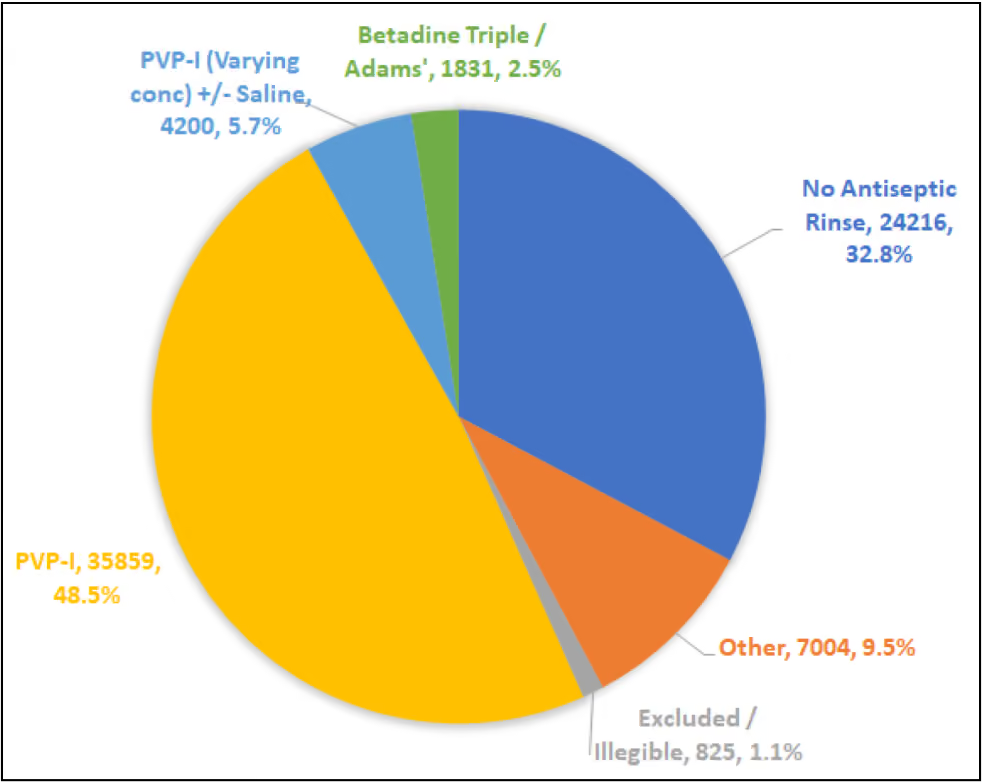
The interesting part is the third that doesn’t
It would be easy to read the 32.8% figure as a failure of practice. The authors are more careful than that, and the paper is more interesting for it.
The evidence base for pocket irrigation, while broad and consistent, is largely retrospective. Systematic reviews support irrigation but hedge their recommendations, citing the shortage of randomised controlled trials and the wide variation in what people actually pour into the pocket. At the same time, prominent authors in the field have argued that running a new randomised trial with a “no irrigation” arm would not be ethically acceptable, given what is already known.
That leaves a genuine gap. And this study identifies a way to fill it: a third of Australian practice, captured prospectively at a national level, is effectively an untreated comparison group that arose naturally. Comparing outcomes between that group and the povidone-iodine group would be the largest study of its kind, without anyone having to be randomised to a control arm.
Why povidone-iodine specifically
Betadine is a practical choice for reasons that have little to do with elegance. It requires no premixing, it is cheap, it is available everywhere, and true allergy to it is rare.
It also has the right coverage. The gram-positive organisms associated with capsular contracture are susceptible to it, and so is Ralstonia, the gram-negative genus found to dominate the microbiome in BIA-ALCL samples. That matters because Ralstonia species are resistant to aminoglycosides, meaning an antibiotic-only rinse may miss exactly the organisms most relevant to lymphoma risk.
Betadine’s history in this space is worth knowing. After Adams’ 2000 in vitro study established the effective concentrations, the FDA issued instructions stating that Betadine should not contact implants, on the basis of concerns that were later disproved. That contraindication has since been rescinded, but the detour explains why alternative antibiotic-only formulations were developed in the intervening years.
For clinicians
Design: Observational study with retrospective analysis of prospectively collected ABDR data. Ethics approval via Monash University HREC (ABDR processes), the ABDR national steering committee, and the University of Sydney HREC.
Inclusion: Patients 18 years and over, surgery between 1 January 2015 and 31 December 2020, first implant insertion for cosmetic augmentation, post-cancer reconstruction, benign or prophylactic reconstruction, or congenital deformity. Excluded: tissue expanders, revision of in situ devices, concurrent mastectomy, axillary surgery including sentinel node biopsy, and concurrent flap cover.
Data handling: The ABDR data collection form permits free text in the “Intraoperative Techniques” section. Entries produced 1,311 distinct free-text values, initially categorised into 48 groups and collapsed into 6 trend categories through a defined sequence: spelling check, homogenisation of nomenclature, conversion of brand to generic names, narrowing by antibiotic class, narrowing by common allergy substitutions, then allocation to major categories. Illegible or meaningless entries (825 implants, 1.1%) were excluded, giving a 97.9% capture of the antiseptic rinse field.
Denominator quality: 88% of eligible sites and 88% of eligible physicians were participating in the ABDR as of 31 December 2020, with a patient opt-out rate of approximately 1%. Estimated capture of true nationwide practice: 87%. The notable gap is Western Australian public hospitals, prevented from participating by state legislation.
International comparison: A 2015 survey of 253 American Society of Plastic Surgery members found Betadine irrigation in 44%, normal saline in 13%, sterile water in 14%, and no irrigation in 2%. The Australian data show a broadly similar dominant practice but a much larger no-antiseptic group.
Acknowledged limitations: No data on concentration or dilution, no contact time recorded (though Adams and Calobrace note full bilateral pocket irrigation takes under 30 seconds and irrigant remains in the pocket at least 18 hours), no access to comorbidity data such as diabetes or immunocompromise, and the possibility of delegated form completion introducing reporting error. The authors note that suboptimal implementation would bias toward underestimating any benefit, meaning a positive finding in the follow-up study would carry additional weight.
Next steps flagged: A retrospective cohort analysis comparing povidone-iodine rinse with no rinse using this population, targeting NHMRC level III-2 evidence, plus proposed amendments to the ABDR data collection form to standardise antiseptic rinse capture.
Reference
Leow SKH, Knight RJW. Contemporary trends in antiseptic pocket rinse in primary breast implant surgery. Aesthetic Surgery Journal. 2023. doi:10.1093/asj/sjad351
This article summarises published research and is general information only. It is not a substitute for individual medical advice.
For a deeper look, download the full paper here.
Latest Insights & Updates
Clinical guidance, procedure information and practice updates from the ISPA Clinic team.

An Australian First: Successful Penile Reimplantation After Complete Amputation

The Cleft Lip Nose: 3D Imaging Overturns What Surgeons Thought Was Happening

Repairing a Transverse Facial Cleft: Why Simple Beats Clever
Ready to Discuss
Your Options?
Every consultation with Dr Knight is unhurried and specific to you, an opportunity to discuss your goals, ask questions and understand what's genuinely right for your anatomy and health. A current GP referral is required for cosmetic surgery consultations.
