
In Australia, a successful reattachment after partial amputation had been reported in Adelaide in 2007. Complete amputation is a considerably harder problem, and until this case no Australian success had been published.
What the operation involved
Two surgical teams worked together: urology and plastic surgery.
The urologists first established a safe route for urine. Examination under anaesthetic confirmed the amputation was within a centimetre of the base. A flexible camera examination showed the remaining urethra was healthy, and a catheter was placed through the lower abdomen directly into the bladder to divert urine while everything healed. The urethral ends were then trimmed, opened out and sewn together over a catheter, and tested to confirm there was no leak. The erectile bodies were repaired next.
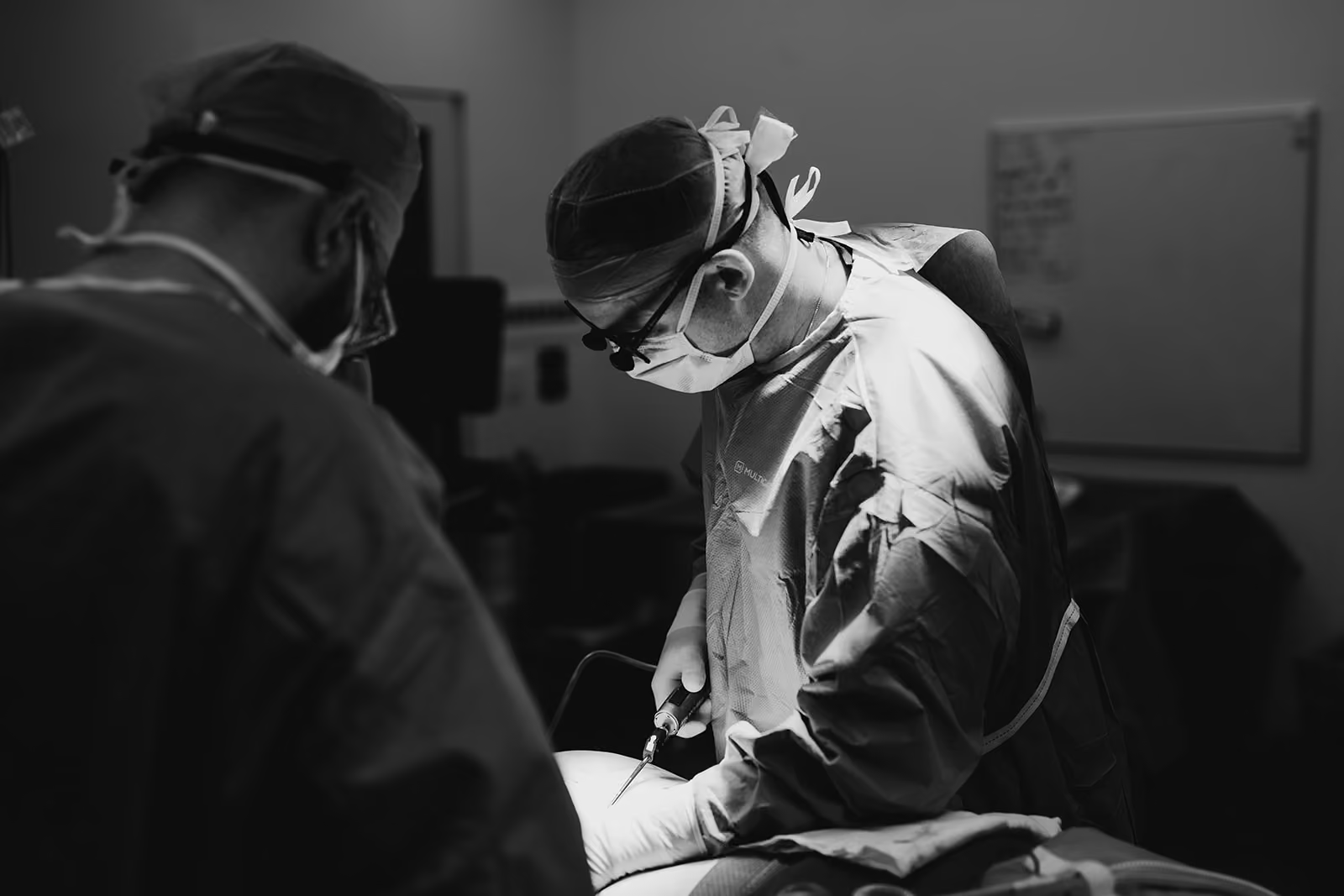
The plastic surgery team then performed the microsurgery: reconnecting the dorsal arteries and vein under the microscope using sutures finer than a human hair, with a 2.5 mm coupling device for the vein. Once the vessels were joined, blood flow through the reattached penis was visible.
The one thing that could not be repaired was the dorsal nerve, which had been torn out rather than cleanly cut. There was nothing to sew to.
Total time without blood supply was approximately 11 hours.
Recovery, and one genuinely surprising result
The first week was spent on strict bed rest, with warming, compression stockings, aspirin and twice-daily heparin to keep the newly joined vessels open, and with smoking cessation, which the patient managed without needing nicotine replacement.
At 48 hours, significant swelling developed beyond the join. It settled on its own. He went home on day 16, after clearance from the mental health team, with both catheters still in place.
A urethral X-ray at six weeks showed no leak, and the urinary catheter came out. By three months there were no urinary symptoms and the bladder catheter was removed. At that point, though, he reported significant erectile dysfunction and no sensation at all.
At 14 months the picture had changed. Urinary flow testing was normal, with a peak flow rate of 24 mL per second and a low residual volume. He reported spontaneous erections. And he reported full penile sensation, which was confirmed on examination.

That last result is the clinically important one. The nerve had never been repaired. Sensation returned anyway, which suggests the dorsal nerve is capable of regenerating across the gap on its own.
The practical conclusion the authors draw is direct: an inability to reconnect the dorsal nerve should not be a reason to decline attempting reimplantation.
What made this case go well
The authors identify the factors that were in this patient's favour, which are also the factors that determine outcome generally:
The single most important of these, from the perspective of anyone who might encounter such an injury, is time. If an amputated part is retrieved and kept cool, and the patient reaches a centre with microsurgical capability quickly, reattachment becomes possible. Common complications, even after successful reattachment, include penile deformity, urethral fistula, urethral stricture and erectile dysfunction, so early specialist involvement matters for the long-term result as well as the immediate one.
For clinicians
Presentation: 25-year-old male, current smoker, one previous mental health admission, presenting two hours after injury with complete amputation within 1 cm of the penile base.
Urological reconstruction: Lithotomy position. Flexible cystoscopy demonstrated healthy urethra proximal to the amputation, a non-occlusive prostate and no bladder pathology. Suprapubic catheter inserted for urinary diversion. Urethral edges debrided, spatulated and anastomosed with interrupted 3-0 polydioxanone over a 16Fr indwelling catheter, with a negative pericatheter leak test. Corporal bodies anastomosed with continuous 2.0 Tycron.
Microsurgery: Dorsal arteries and vein anastomosed with 9.0 nylon and a 2.5 mm venous coupler respectively. Dorsal nerve avulsed and considered irreparable; no formal repair performed. Visible perfusion of repaired penile vessels following anastomosis. Total ischaemic time approximately 11 hours.
Postoperative protocol: IDC secured to the leg with Hypafix for stabilisation and glans elevation. Strict bed rest for 7 days. Forced-air warming, TED stockings, aspirin 100 mg daily, subcutaneous heparin 5000 U twice daily, smoking cessation. Significant penile oedema distal to the anastomosis developed at approximately 48 hours and self-resolved without pressure dressings. Discharged day 16 following mental health clearance with SPC and IDC in situ.
Follow-up: Six-week peri-urethrogram confirmed no anastomotic leak; IDC removed. Three months: no lower urinary tract symptoms, SPC removed; significant erectile dysfunction with absent penile sensation. Fourteen months: no lower urinary tract symptoms; uroflow Qmax 24 mL/s after voiding 365 mL with post-void residual 59 mL; spontaneous erections reported; full penile sensation reported and confirmed on examination.
Context: Self-mutilation accounts for 87% of reported penile amputations. Managing the psychiatric presentation alongside the reconstruction is part of the case, not adjacent to it, and in this instance discharge was contingent on mental health team clearance.
Reference
Cooper H, Parkin CJ, Cole-Clark D, Self D, Katupitiya D, Knight R, Tran M. Penile reimplantation following traumatic complete amputation: an Australian first. ANZ Journal of Surgery. 2024;94(1-2):254-256. doi:10.1111/ans.18726
This article summarises a published case report and is general information only. It discusses an injury resulting from self-harm. If this raises difficulties for you, support is available in Australia through Lifeline on 13 11 14 and beyondblue on 1300 22 4636, and your GP can help you find ongoing care.
For a deeper look, download the full paper here.
Latest Insights & Updates
Clinical guidance, procedure information and practice updates from the ISPA Clinic team.
An Australian First: Successful Penile Reimplantation After Complete Amputation
The Cleft Lip Nose: 3D Imaging Overturns What Surgeons Thought Was Happening
Repairing a Transverse Facial Cleft: Why Simple Beats Clever
Ready to Discuss
Your Options?
Every consultation with Dr Knight is unhurried and specific to you, an opportunity to discuss your goals, ask questions and understand what's genuinely right for your anatomy and health. A current GP referral is required for cosmetic surgery consultations.
