
Between 2007 and 2016, 55 women in Australia and New Zealand were diagnosed with a rare cancer linked to their breast implants. A joint Australia and New Zealand task force set out to answer a question nobody had been able to answer properly until then: how big is the risk, and does it depend on which implant you have?
The answer, published in Plastic and Reconstructive Surgery, was that the implant surface matters enormously. Dr Robert Knight was one of the surgeon authors on the study.
What is BIA-ALCL?
Breast implant-associated anaplastic large cell lymphoma (BIA-ALCL) is not breast cancer. It is a lymphoma, a cancer of immune system cells, that develops in the scar capsule the body forms around a breast implant. It is rare, and when it is caught early it is usually curable by removing the implant and the capsule around it.
In this series, roughly three quarters of women (76%) presented with a swollen breast caused by fluid collecting around the implant, known as a seroma. Around one in five presented with a lump. On average, symptoms appeared about seven and a half years after the implant was put in, though the range was wide, from a few months to 27 years.
Why the risk had been so hard to pin down
Earlier estimates of BIA-ALCL risk ranged from 1 in 50,000 to 1 in 3,000,000. That is not a small discrepancy, and it left both surgeons and patients without a usable number.
The problem was arithmetic. To calculate a risk you need a numerator (how many cases) and a denominator (how many implants were actually put in). Cases were being missed, duplicated across registries, or misdiagnosed. And implant sales figures were commercially sensitive, so nobody outside the manufacturers knew the denominator.
The task force solved both halves. It captured and independently confirmed every reported case in the region, and it persuaded three major manufacturers, Mentor, Allergan and Silimed, to release sales data going back to 1999.
The finding: surface area drives risk
Every one of the 55 patients had been exposed to a textured implant at some point. When the researchers examined the implant surfaces under confocal and scanning electron microscopy, a pattern emerged. Implants with more surface area carried more risk.
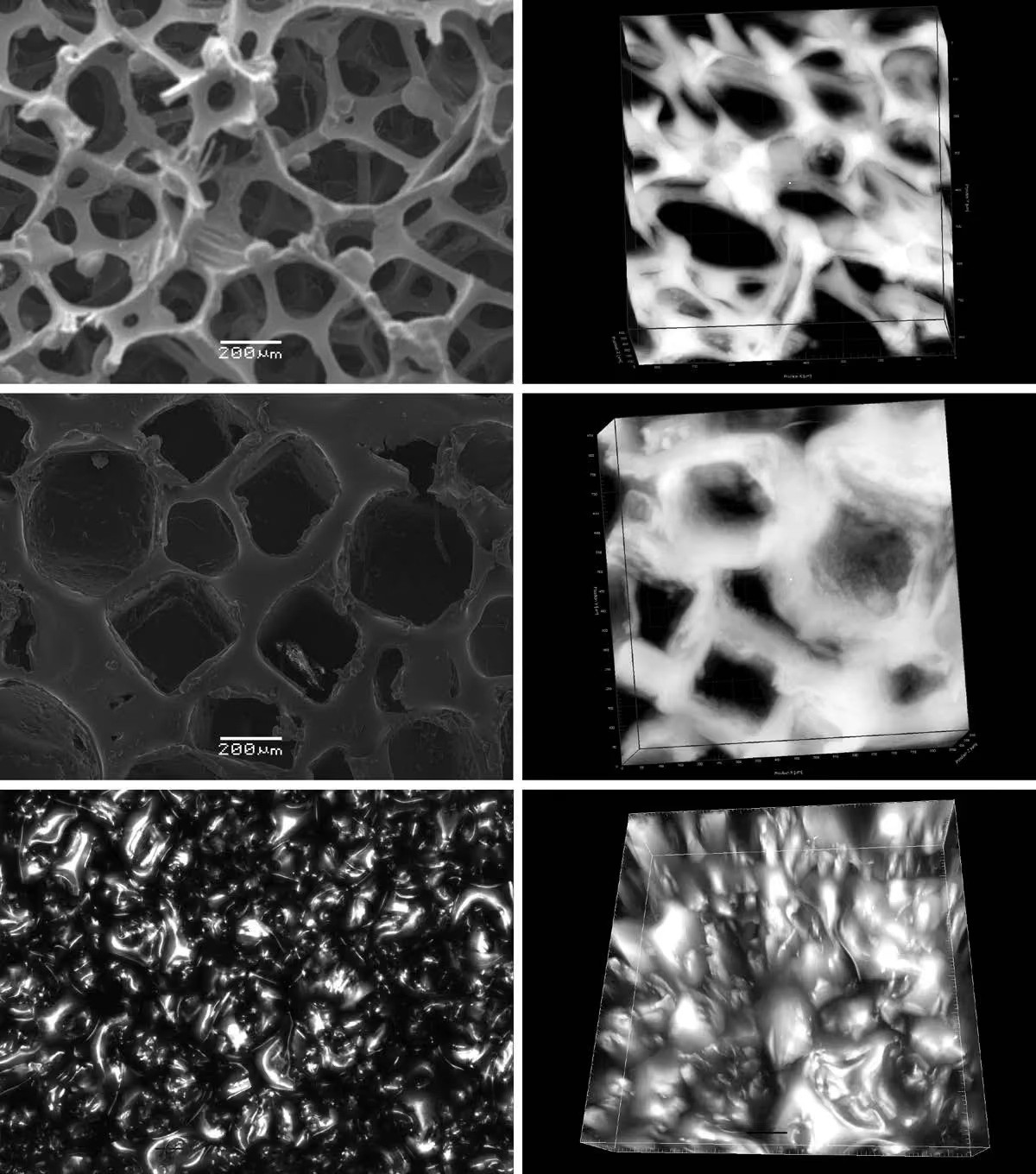
Measured across a 1 mm by 1 mm patch, a smooth implant has about 1 mm² of actual surface. Siltex texturing has about 12 mm². Biocell has about 28 mm². Polyurethane has about 147 mm².
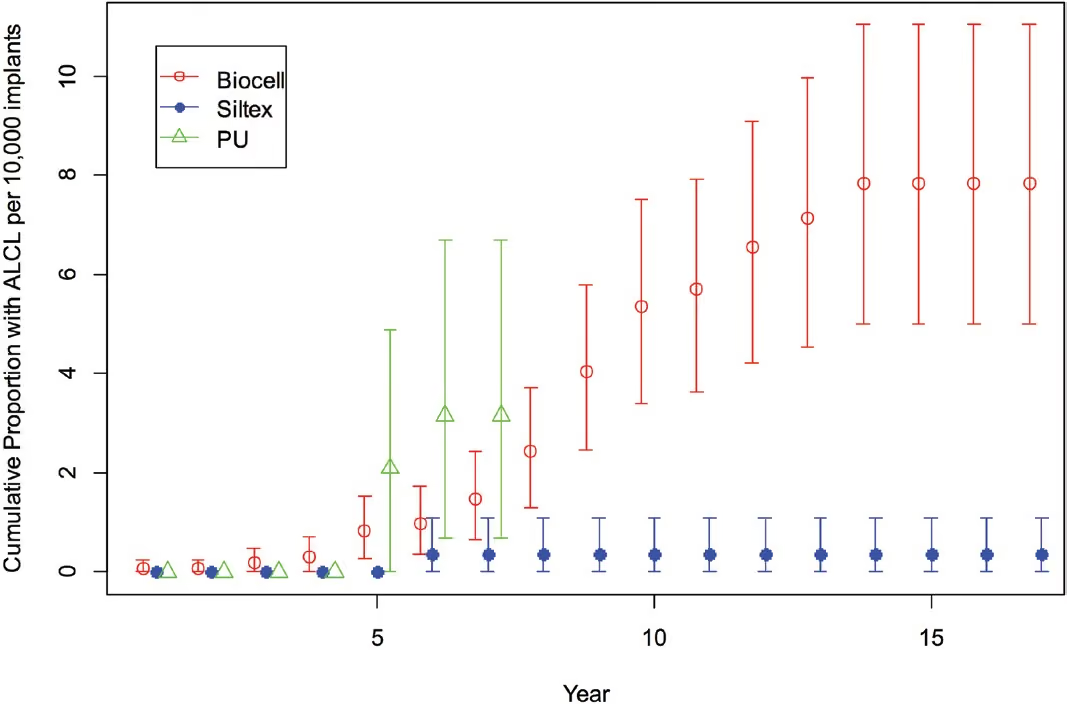
The risk estimates tracked that ranking closely:
Put another way, the risk with Biocell implants was roughly 14 times that of Siltex, and polyurethane roughly 11 times.
Why texture would matter at all
The explanation the authors put forward is bacterial. A textured surface is a better platform for bacterial biofilm to grow on than a smooth one. More surface area means more room for bacteria, and once the bacterial load passes a certain threshold it can drive chronic inflammation in the surrounding tissue. In a genetically susceptible person, over many years, that sustained immune activation may push T-cells toward malignant transformation.
It is a multi-factor story: surface area, bacterial contamination, host susceptibility, and time. That framing matters practically, because it points to something surgeons can control. Bacteria get into the implant pocket at the time of surgery. Reduce the contamination at that moment and you may keep the biofilm below the threshold that starts the whole cycle.
What this means if you have implants
A few points worth being clear about.
The risk is low, but it is not zero. Even at the highest estimate, this is roughly one case in every four thousand implants. Most women with textured implants will never develop BIA-ALCL.
Outcomes are good when it is found early. In this series, 51 of the 55 patients (93%) were alive and disease-free at the end of the study. The four deaths all involved disease that had grown as a mass and spread beyond the capsule, which is why early presentation matters so much.
Know the symptom to watch for. Sudden swelling of one breast, months or years after surgery, is the presentation to take seriously. It is usually not cancer, but it always warrants assessment.
Routine removal of symptom-free implants is not recommended. Since this study was published, the regulatory landscape has changed substantially. Allergan recalled its Biocell textured implants worldwide in July 2019, and the Therapeutic Goods Administration took action against a range of textured implant products in Australia across 2019 and 2020. Australian guidance continues to advise that implants in place should not be removed simply because of the product classification, in the absence of symptoms. If you are unsure which implant you have, your operating surgeon or the Australian Breast Device Registry can help you find out.
For clinicians
Study design: All BIA-ALCL cases in Australia and New Zealand were captured by a joint task force, with pathological diagnoses independently confirmed and TNM staging applied. Implant sales data from Mentor, Allergan and Silimed (1999 to 2015) provided the denominator. Incidence was calculated using the Poisson distribution with exact confidence intervals; cumulative proportions by texture used Kaplan-Meier estimates with parametric bootstrap confidence intervals; between-group comparison used discrete-time survival analysis with exact-like logistic regression.
Cohort: 55 patients, 75 implants (11 patients had multiple-implant exposure). Mean age 47.1 years (22.4 to 69.6). Mean time from last implantation to diagnosis 7.46 years (0.2 to 27.0). Indication was cosmetic augmentation in 38 patients (69.1%) and post-mastectomy reconstruction in 17.
Implant distribution: Biocell salt-loss 44 of 75 implants (58.7%), Silimed polyurethane 14 (18.7%), Nagor salt-loss 5, Mentor Siltex 5. Higher-surface-area textures accounted for 64 of 75 implants (85.3%).
Pathology and staging: All specimens CD30+, ALK−. Disease was confined to the peri-implant effusion in 32 patients (58.2%, T1N0M0), populated the luminal capsule surface without invasion in 10 (18.2%), and infiltrated the capsule in 12 (21.8%). Four deaths, all in patients with mass disease extending beyond the capsule. Two of five local recurrences occurred in patients with positive margins at index surgery, underlining the case for complete oncological capsulectomy and multidisciplinary assessment.
Risk: Odds ratio for Biocell versus Siltex 14.11 (95% CI 1.20 to 561.46; p = 0.0005); polyurethane versus Siltex 10.84 (95% CI 1.00 to 566.34; p = 0.05). Cumulative risk for Biocell rose significantly after approximately 8 years of exposure, peaking at 12 years.
Limitations acknowledged by the authors: small case numbers for Siltex and polyurethane producing very wide confidence intervals, shorter market exposure for Silimed in the region, reliance on manufacturer-supplied sales data, cluster patterns of incidence, and the possibility of unidentified cases through missed clinical or pathological diagnosis.
Practice implication: The authors position anti-infective strategy, specifically the 14-point plan, as the primary modifiable lever. Adams et al. reported no cases across 42,000 macrotextured implants where those measures were applied. Higher-surface-area devices reduce the margin for error, so contamination control becomes more critical, not less.
Reference
Loch-Wilkinson A, Beath KJ, Knight RJW, Wessels WLF, Magnusson M, Papadopoulos T, Connell T, Lofts J, Locke M, Hopper I, Cooter R, Vickery K, Joshi PA, Prince HM, Deva AK. Breast implant-associated anaplastic large cell lymphoma in Australia and New Zealand: high-surface-area textured implants are associated with increased risk. Plastic and Reconstructive Surgery. 2017;140(4):645-654.
This article summarises published research and is general information only. It is not a substitute for individual medical advice. If you have concerns about your breast implants, please book a consultation.
For a deeper look, download the full paper here.
Latest Insights & Updates
Clinical guidance, procedure information and practice updates from the ISPA Clinic team.
An Australian First: Successful Penile Reimplantation After Complete Amputation
The Cleft Lip Nose: 3D Imaging Overturns What Surgeons Thought Was Happening
Repairing a Transverse Facial Cleft: Why Simple Beats Clever
Ready to Discuss
Your Options?
Every consultation with Dr Knight is unhurried and specific to you, an opportunity to discuss your goals, ask questions and understand what's genuinely right for your anatomy and health. A current GP referral is required for cosmetic surgery consultations.
